.jpg)
.jpg)
.jpg)
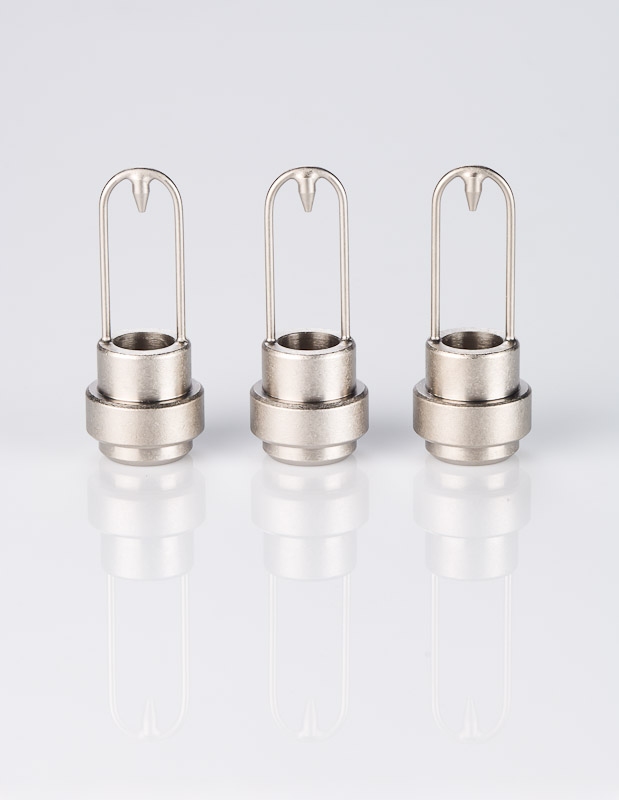
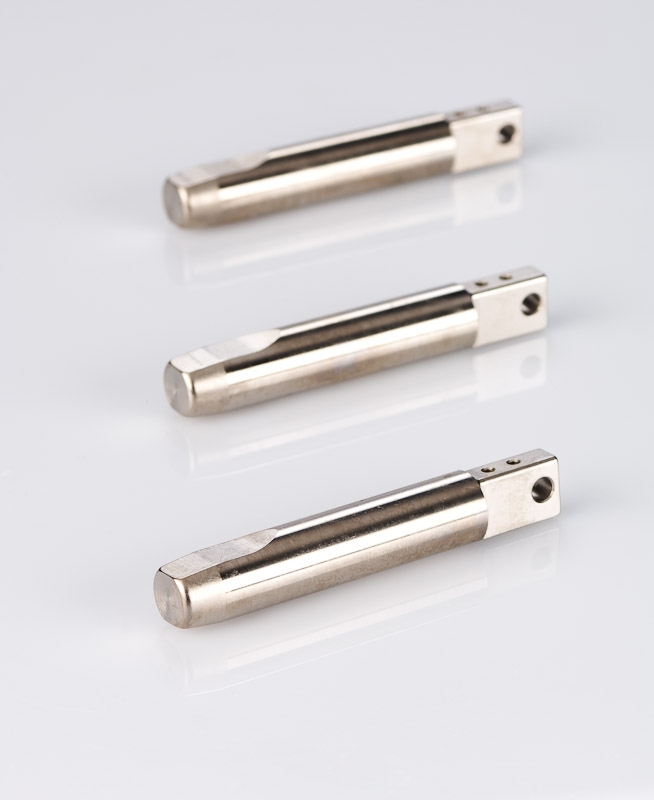
.jpg)
.jpg)
.jpg)
Electroless nickel, as opposed to other electrolytic coatings, does not require current or anodes.
The coating is carried out in a watery solution, containing metallic ions, complexes and stabilizers.
A chemical reaction occurs on the surface area, creating a layer of alloy, contains nickel and phosphor.
Since the contact surface between the solution and surface is direct the thickness of the coating is mainly uniform.
A unique characteristic of the electroless nickel allows penetration of the coating into internal parts, even in complex structures engineering-wise.
This uniformity of the electroless coating is extremely hard to get and even cannot be created by any other procedure.
The electroless layer is an alloy containing nickel and phosphor, of which 90% is nickel.
In the electroless nickel coating, high as well as low thickness can be reached, thanks to its uniqueness, so that the upper layer of the coating consists of a catalysator for the continuation of the reaction.
The thickness of the coating can vary from 2 micron up to 30 micron.
Compared to other coatings, electroless nickel is relatively new, yet it is greatly used, mainly in engineered coatings but also in decorative coatings, requiring corrosion resistance (according to the type of electroless)
The procedure in our factory is carried out according to:
AMS-C-26074, or ASTM B733.
The thickness of the coating and the treatments is displayed in the tables below:
| Grade A | Grade B | Grade C |
| 25 micron minimum | 12.5 micron minimum | 38 micron minimum |
| Class I | Without thermal treatment on ferrous and copper bases |
| Class II | With thermal treatment on ferrous and copper bases |
| Class III | With thermal treatment on aluminum and copper beryllium alloys that are not react to thermal treatment |
| Class IV | With thermal treatment on aluminum and copper alloys that react to thermal treatment |
| Type I | No demand for phosphorus | 0% phosphorus |
| Type II | 1%-3% phosphorus | Low phosphorus |
| Type III | 2%-4% phosphorus | Low phosphorus |
| Type IV | 5%-9% phosphorus | Medium phosphorus |
| Type V | 10% and above | High phosphorus |
| Service Condition 0 | 0.1 micron minimum |
| Service Condition 1 | 5 micron minimum |
| Service Condition 2 | 13 micron minimum |
| Service Condition 3 | 25 micron minimum |
| Service Condition 4 | 75 micron minimum |
| Class 1 | Without thermal treatment | ||
| Class 2 |
Thermal treatment for hardness enlargement |
Type I Type II Type III Type IV Type V |
260°c 20 hours or 285°c 16 hours or 320°c 8 hours or 400°c 1 hour 350°c-380°c 1 hour 360°c-390°c 1 hour 365°c-400°c 1 hour 375°c-400°c 1 hour |
| Class 3 | Thermal treatment for adhesion improvement on ferrous alloys | 180°c-200°c 2-4 hours | |
| Class 4 | Thermal treatment for adhesion improvement on ferrous alloys containing carbon and hardened aluminum | 120°c-130°c 1-6 hours | |
| Class 5 | Thermal treatment for adhesion improvement on beryllium and aluminum alloys | 140°c-150°c 1-2 hours | |
| Class 6 | Thermal treatment for adhesion improvement on titanium | 300°c-320°c 1-4 hours |
In cases where there is demand for different qualities than the above,
a different type of electroless nickel (with a lower or a higher quantity of phosphorus)
can be ordered. The electroless nickel coating is not poisonous and authorized by
the American Health Organization as the best coating for cutlery.
The Electroless nickel processes in our plant are medium phosphorus electroless nickel and high phosphorus electroless nickel, where the main characters of this processes are:
| Type of -Nickel phosphor | Medium phosphorus 6-8%{w} | High phosphorus 8-12%{w} |
| Appearance | Very shiny | Shiny |
| Melting point | 680°c -960°c | 880°c |
| Electrical resistance | 75microohm cm | 100 microohm cm |
| Hardness |
550 Vickers before thermal treatment {about 50RC} 950 Vickers after thermal treatment {about 70RC} |
530 Vickers before thermal treatment {about 48RC} 1050 Vickers after thermal treatment {about 80RC} |
| Corrosive resistance | 100 hours in a salt spray chamber according to ASTM B117 | 100 hours in a salt spray chamber according to ASTM B117 |
| Magnetic qualities | Slightly magnetic | Non magnetic |
In cases where there is demand for different qualities than the above,
a different type of electroless nickel (with a lower or a higher quantity of phosphorus)
can be ordered.


